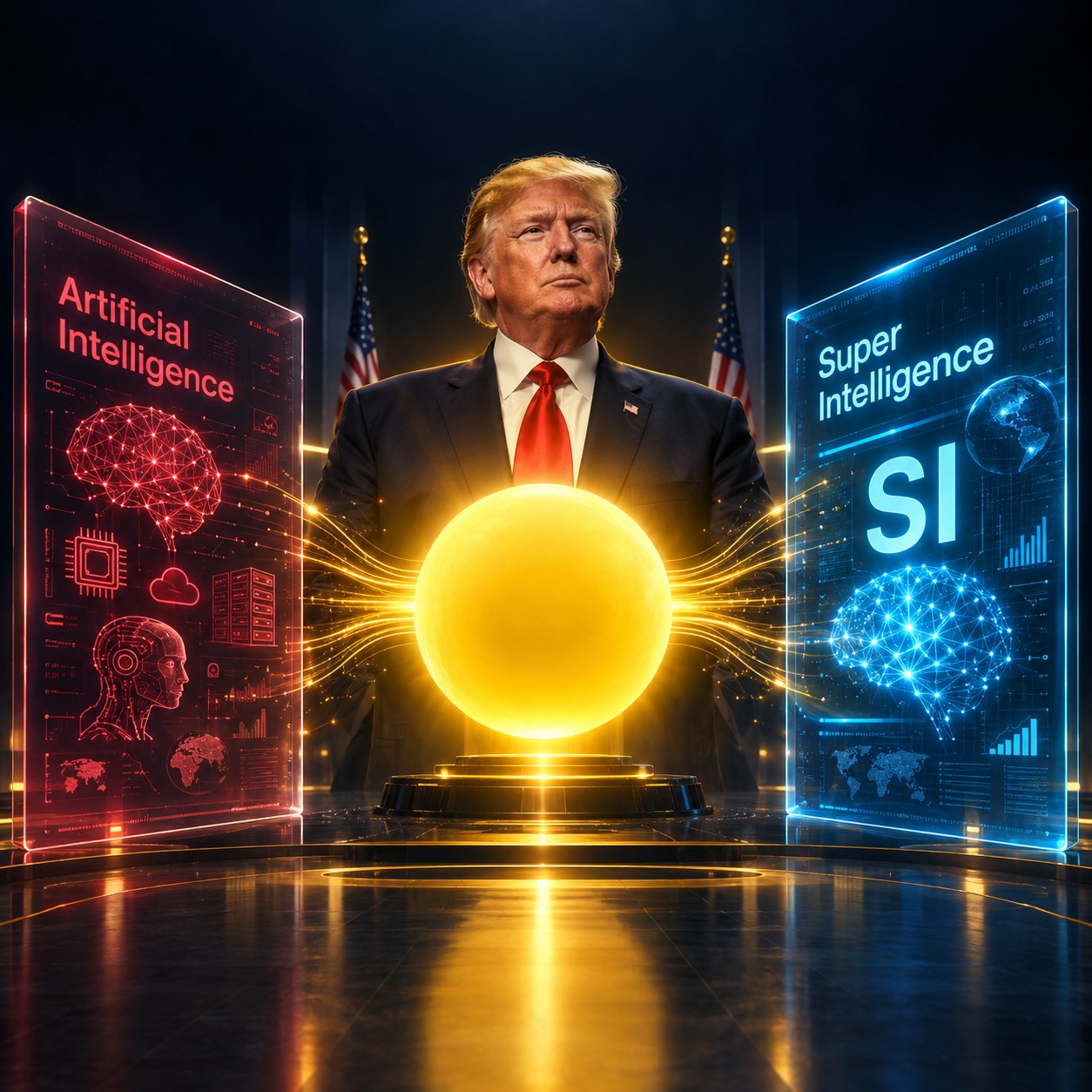
In a move that has reignited a fierce debate across the global technology and foreign policy landscapes, U.S. President Donald Trump signed an executive order directing federal agencies to phase out the terms “Artificial Intelligence” and “AI” in official communications. In their place, the executive branch is mandated to adopt “Super Intelligence” and its new acronym, “SI.”
The directive formalizes a policy pivot initially unveiled during the President’s address to the United Nations General Assembly in New York, where he argued that the word “artificial” undermined the technology by making it sound “fake.” The administration contends that current frontier models have evolved past simple automation, requiring a label that accurately reflects their transformative trajectory.
1. The Administration’s Strategy: Optics, Acceleration, and National Power
The shift to "SI" represents more than a linguistic preference; it forms a core pillar of the White House’s strategy to project American technological dominance on the global stage.
The Ideological Pivot: By rejecting the label "artificial," the administration seeks to emphasize the boundless utility and economic potential of emerging technologies—arguing that today’s models actively enhance human capability rather than merely simulate it.
Public Consensus via Social Media: Prior to the official order, President Trump polled followers on his Truth Social platform, offering options such as “superior,” “extreme,” and “supreme intelligence,” with “super intelligence” ultimately emerging as the winner.
Structural Integration: To institutionalize the vision, the White House announced the creation of a dedicated “Super Intelligence Force.” The policy task force will be headed by Director of National Intelligence Jay Clayton, tasked with coordinating federal policy to maintain U.S. leadership over key global rivals.
Policy Initiatives: The executive order builds upon previous White House milestones, including the release of America’s AI Action Plan and over $5 billion earmarked for the Genesis Mission—a national initiative aimed at deploying super intelligence across science, medicine, and manufacturing.
2. Academic Scepticism: The Widening Gap Between Hype and Technical Reality
While the administration frames the new terminology as a reflection of rapid progress, computer scientists, ethicists, and policy experts have expressed strong reservations, warning that the rebrand conflates current capabilities with hypothetical future developments.
Conflating Today’s Tools with Tomorrow’s Concepts: In technical and academic circles, superintelligence—a concept popularized over a decade ago by philosopher Nick Bostrom—specifically describes a theoretical machine intellect that vastly surpasses human cognitive capacity across every domain. Experts stress that current narrow models remain far from this threshold.
Exaggeration and Confusion: Researchers from the University of Melbourne and the National University of Singapore cautioned that using "SI" to describe today’s generative tools misrepresents their actual boundaries. They warn that the label artificially inflates hype, complicates international governance frameworks, and could needlessly heighten public anxiety regarding safety risks.
3. Industry Split and Geopolitical Reactions
The international and domestic response to Washington’s rebranding mandate has highlighted deep political and industrial fault lines across various stakeholders:
Industry Supporters: Jensen Huang, CEO of Nvidia, backed the move, stating on X that super intelligence presents an extraordinary opportunity to advance discovery, productivity, and health across the economy.
Administration Allies: U.S. Chief Technology Officer Ethan Klein and UN Ambassador Michael Waltz swiftly embraced the shift, framing it as a bold and necessary statement of American global leadership.
Domestic Opposition: Gavin Newsom, Governor of California, strongly rejected the mandate and ordered California state agencies to retain "AI." Newsom criticized the move as a political distraction designed to mask a failure to address critical safety risks.
Tech Leaders & Friction: Elon Musk briefly slipped up by using the old term alongside President Trump before correcting himself ("SI, pardon me"). The incident underscores the awkward transition facing tech executives who previously advocated pacing model development over safety concerns.
International Reaction: Beijing has approached the shift with diplomatic caution. China’s Foreign Ministry stated it "respects" Washington’s decision but confirmed Beijing will stick to the standard term "artificial intelligence." Analysts view the change as an idiosyncratic preference that holds little weight in broader international scientific policy.
Summary of Key Insights
Strategic Narrative Control: The transition to "SI" is designed to align federal rhetoric with aggressive, deregulatory tech expansion—positioning the U.S. to outpace China in an unconstrained technological race.
Technological Disconnect: The academic community remains firmly opposed to using "superintelligence" for existing systems, maintaining that current AI lacks the generalized, self-improving capabilities the term technically implies.
Institutional Divergence: Domestic political divides (such as California’s refusal to adopt the terminology) and international indifference indicate that while "SI" will define executive federal policy, the broader global industry will likely stick with "AI."
🔗 Sources: BBC News, The National Desk (TNND), Executive Order Fact Sheet (White House).
Rebranding AI: Trump’s Shift to ‘Super Intelligence’ and the Battle for the Tech Narrative

Rebaz Ahmed
Article author